As AI Takes Over the Classroom, Are Students Losing the Art of Thinking?
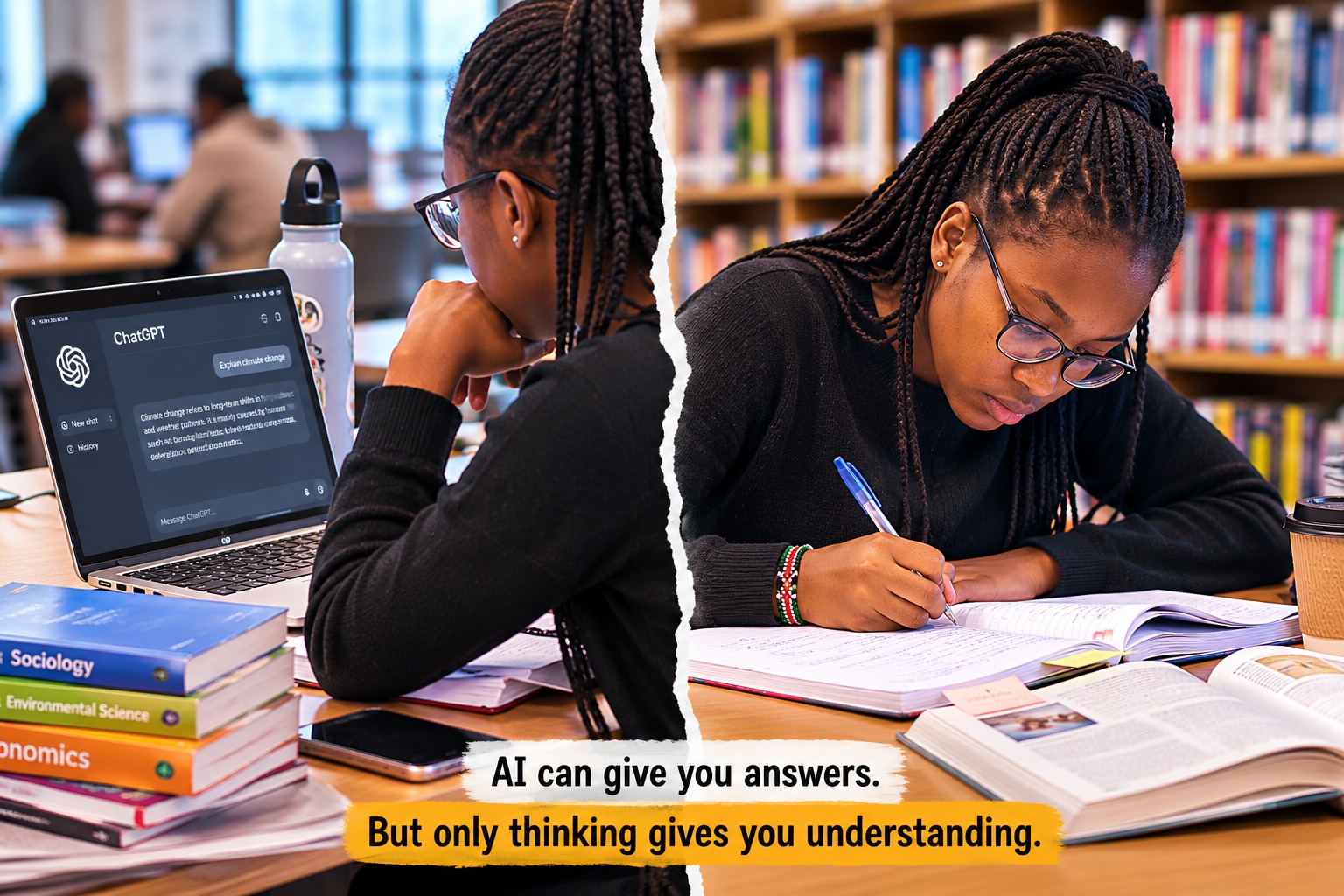
A university assignment that once took days to research can now be completed in minutes. A mathematics problem is solved with a single prompt. Essays, presentations and even computer code are increasingly being generated by artificial intelligence (AI), raising fresh questions about the future of learning.
Across the globe, AI has rapidly become part of everyday education. In Kenya, where internet access and smartphone ownership continue to expand, students are among the fastest adopters of generative AI tools. While the technology promises to make learning more accessible, education experts are warning that convenience should not come at the expense of critical thinking.
The Organisation for Economic Co-operation and Development (OECD), in its Digital Education Outlook 2026, notes that AI has the potential to transform education but cautions that schools must continue to nurture reasoning, creativity and independent problem-solving. UNESCO has echoed similar concerns, urging education systems to ensure AI supports learning rather than replacing the intellectual effort that helps students develop lifelong skills.
The debate comes at a time when Kenya is positioning itself as a regional technology hub. According to the Communications Authority of Kenya, internet penetration has surpassed 90 per cent, while mobile broadband subscriptions continue to rise, giving millions of young people instant access to AI-powered platforms. At the same time, the Kenya National Bureau of Statistics (KNBS) estimates that nearly three-quarters of Kenya's population is below the age of 35, making today's students the country's future workforce.
Education specialists argue that the greatest risk is not AI itself but how it is being used.
When learners rely on AI to generate assignments without understanding the content, they may lose valuable opportunities to practise analysing information, constructing arguments and solving problems independently. These are the very skills employers increasingly value in a rapidly changing digital economy.
Universities around the world are already adapting. Several institutions in Australia, Canada and Europe have begun redesigning assessments by introducing oral examinations, practical projects and supervised coursework that require students to demonstrate their own understanding rather than simply submitting AI-generated responses.
For teachers, the challenge is equally significant. Instead of banning AI altogether, many educators are encouraging students to use it as a learning companion asking it to explain difficult concepts, provide feedback on written work or suggest additional resources , while ensuring the thinking and final decisions remain their own.
The conversation also extends beyond academic performance. Cognitive scientists have long argued that memory, reasoning and creativity improve through repeated mental effort. Reading deeply, writing independently, debating ideas and working through difficult problems all strengthen the brain in ways that instant answers cannot.
As Kenya continues to embrace digital transformation, the education sector faces an important balancing act. AI is likely to become as common in classrooms as calculators and search engines once did. The question is no longer whether students should use AI, but whether they can use it without sacrificing the habits of curiosity, persistence and independent thought that define meaningful learning.
For organisations such as Learning for Tomorrow Foundation, the future of education lies in preparing learners who are not only digitally skilled but also capable of questioning, analysing and creating. Technology will continue to evolve, but the ability to think critically remains one of the most valuable skills any student can develop.