Who Teaches the Teachers? Why the Future of Education Depends on Educators
We often ask whether children are ready for the future.
Are they developing the digital skills they will need? Can they think critically? Are they prepared for a changing world of work?
These are important questions. But there is another question we should ask:
Who is preparing the people responsible for preparing them?
At the center of every classroom is a teacher. Yet the role of the teacher is changing rapidly. Technology is transforming how people learn and work. Artificial intelligence is changing how information is created and accessed. Employers are looking for new combinations of technical and human skills, while learners are growing up in a world very different from the one their teachers experienced.
Preparing young people for this world means preparing teachers for it too.
Teaching is changing
Teaching is no longer simply about delivering information. Information is available almost everywhere, often within seconds.
The teacher's role is increasingly about helping learners understand, question and apply that information. Teachers are expected to encourage creativity, critical thinking, collaboration and problem-solving while also responding to new technologies and different learning needs.
Kenya's National Education Sector Strategic Plan 2023–2027 recognizes the importance of continuous professional development, innovative teaching approaches and the effective use of technology in education. (Ministry of Education)
This reflects an important reality: an education system cannot prepare learners for a changing world if its educators are not given opportunities to keep learning themselves.
Training is important, but it is only the beginning
Kenya is already making progress in this area.
In 2026, UNESCO brought together 60 master trainers from eight Kenyan universities to strengthen teacher professional development through mobile learning. The initiative recognizes that traditional professional development can be difficult to access because of time, location and other barriers. (UNESCO)
There is also growing investment in digital and artificial intelligence skills for educators. UNESCO's AI EmpowerED programme aims to reach 500,000 teachers and students by the end of 2026 across participating countries, including Kenya. (UNESCO)
These efforts are important. But professional development should not end when a workshop does.
A teacher can attend training on AI, digital learning or innovative pedagogy and return to a classroom where there may be limited devices, connectivity challenges, heavy workloads or little opportunity to practice what they have learned.
This is why training and transformation are not the same thing.
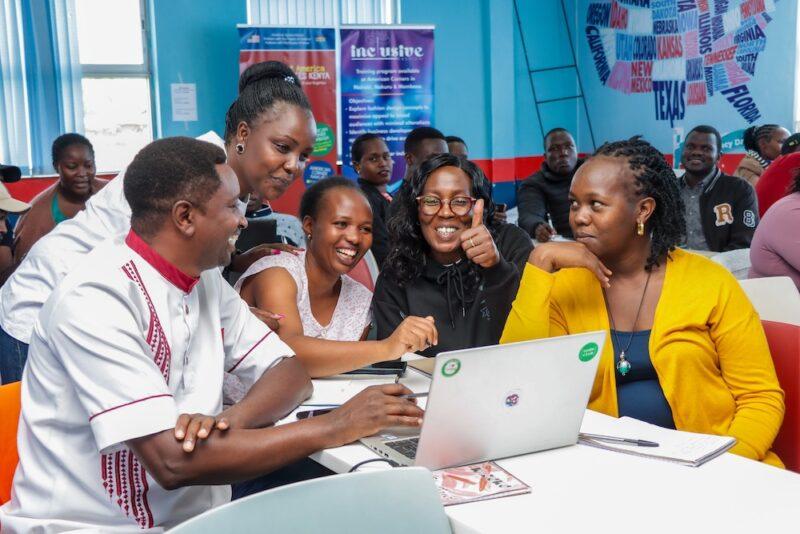
Teachers need opportunities to practice new approaches, receive feedback, learn from colleagues and adapt ideas to their own classrooms.
Teachers need learning communities
Professional development becomes more meaningful when teachers can learn from one another.
A teacher experimenting with a new teaching method should have somewhere to share the experience. Someone struggling to integrate technology should be able to learn from another educator who has already faced the same challenge.
This can happen through professional learning communities, mentorship, peer networks and accessible digital learning opportunities.
It also means recognizing that there is no single solution for every classroom. Kenya's schools serve different communities and face different realities. What works in one setting may need to be adapted in another.
Teachers therefore need more than instructions. They need skills, confidence, support and space to experiment.
Teachers are lifelong learners too
We encourage children to remain curious and adaptable because the world will continue to change.
Teachers deserve the same opportunity.
They cannot be expected to know everything about every emerging technology, teaching method or future challenge. What matters is whether they have access to continuous learning and support.
When teachers are treated as lifelong learners, they become more than curriculum deliverers. They become problem-solvers, innovators and active contributors to improving education.
And the impact can extend far beyond one classroom.
A teacher who develops stronger digital skills can influence hundreds of learners. A teacher who learns how to encourage critical thinking can help young people become more confident decision-makers. A teacher who understands different learning needs can help ensure that fewer learners are left behind.
Investing in teachers is therefore an investment in learners, families and communities.
Conclusion: Preparing those who prepare the future
The conversation about the future of education often focuses on technology, artificial intelligence and the skills young people will need for tomorrow's jobs.
But behind every learner is a teacher.
A new device cannot teach itself. A curriculum cannot implement itself. An AI tool cannot replace the relationships, judgement and understanding that make learning meaningful.
People make education work.
That is why preparing teachers must be at the heart of preparing young people for the future. Organizations such as the Learning for Tomorrow Foundation have an important role to play in supporting educators with opportunities for continuous learning, digital skills, innovative teaching approaches and meaningful professional networks.
If we want learners who can adapt to change, we must support teachers to adapt too.
The future of education does not begin with the technology we put in classrooms. It begins with the people we empower to use it.